A Mercedes-Benz is one of the most precisely engineered vehicles on the road — and like any precision instrument, it rewards consistent attention and punishes neglect. The owners who get 200,000 miles from a C-Class, or keep a decade-old E-Class running like it left the showroom last year, are not simply lucky. They follow a disciplined maintenance schedule, use the correct fluids and parts, and bring their vehicle to technicians who understand these systems at a technical level, not a generic one.
At Revolution Automotive in Norwood, MA, we have worked exclusively on European vehicles for over 25 years. A significant portion of that work is Mercedes-Benz — from C-Class and GLC daily drivers to high-mileage E-Class wagons and AMG enthusiasts. The pattern we observe is consistent: the vehicles that remain reliable and hold their value belong to owners who treat maintenance as an investment rather than an inconvenience. A deferred oil change, a brake fluid flush skipped for a third year, a battery replaced without BMS registration — small decisions compound into expensive repairs.
This guide shares what our Mercedes-Benz specialists have learned from years of hands-on experience: the maintenance schedule that protects your investment, the critical service intervals most owners miss, the technical details that matter, and the early warning signs that should never be ignored or deferred.
Why Mercedes-Benz Vehicles Require Specialized Expertise
Spend enough time working on German engineering and the patterns become clear: these vehicles were built with a level of systems integration that most other manufacturers don't approach. That integration is what makes them exceptional to drive — and what makes them demanding to service correctly.
A modern Mercedes-Benz contains 50 to 100 separate electronic control modules that communicate over a CAN bus network. The engine management module shares data with the transmission, which shares data with the ESP stability system, which communicates with the ABS module, which ties into the body control system. A fault in one area can produce symptoms in a completely unrelated area. Diagnosing a Mercedes correctly means reading all of those modules simultaneously — not just the one that turned on a warning light.
Fluid specifications matter here in ways they don't on most vehicles. Mercedes engines require MB 229.5 or 229.51 specification oil — full synthetic, correct viscosity, with the specific additive package the engine was designed around. The 7G-Tronic and 9G-Tronic automatic transmissions are equally specific about fluid grade. These aren't upsells — they're engineering requirements built into the tolerances of the components themselves.
Calibration procedures are required after many common repairs that wouldn't need them on other cars. Replacing a Mercedes battery without registering it to the battery management system causes the charging circuit to apply the wrong charge curve, shortening the new battery's life by years. Replacing brake pads on certain models requires a service reset via Xentry. Throttle body replacement requires an electronic adaptation. These steps aren't optional — skipping them degrades performance and can damage the components you just replaced.
Specialized tooling is also often required for jobs that appear straightforward. Several Mercedes suspension components, camshaft procedures, and transmission-adjacent repairs cannot be done correctly — or safely — without manufacturer-specific tools. Our shop is properly equipped because doing the job right the first time is less expensive than returning to correct an avoidable mistake.
The Complete Mercedes-Benz Maintenance Schedule
Mercedes-Benz maintenance is not a generic service interval — it is a carefully engineered schedule calibrated to the specific systems, fluids, and wear patterns of these vehicles. Understanding what each service includes, and when to perform it, is the foundation of long-term Mercedes-Benz ownership.
Service A — Your Annual Maintenance Foundation
Service A is due at approximately 10,000 miles or one year, whichever comes first. It is the baseline maintenance interval that keeps the engine and fluid systems healthy between the more comprehensive Service B visits. The ASSYST Plus system in your instrument cluster calculates the interval based on actual driving conditions — but as we explain below, the indicator is a guide, not the final word.
- •Synthetic motor oil replacement using MB 229.5 or 229.51 specification
- •Oil filter replacement
- •All fluid levels checked and corrected — coolant, brake fluid, power steering, washer
- •Tire pressure check and inflation to specification
- •Brake component visual inspection
- •Service indicator reset via factory Xentry software
The most common Service A mistake we see: owners wait for the ASSYST indicator to reach zero before booking an appointment. ASSYST calculates the ideal interval for moderate driving conditions — not for New England winters, short trips around Norwood, or Route 1 stop-and-go traffic. These conditions degrade oil faster than the algorithm accounts for. For local driving patterns, 7,500 to 10,000 miles is a safer interval than the full 12,000 to 15,000 miles the system may suggest.
Service B — The Comprehensive Two-Year Service
Service B is due at approximately 20,000 miles or two years, alternating with Service A. It includes everything in Service A and adds the components most critical for long-term reliability:
- •Cabin microfilter (pollen filter) replacement — seasonal pollen and road dust load these filters quickly in the Norwood area
- •Brake fluid flush — non-negotiable for New England vehicles; see the brake fluid section below for the engineering reason
- •Tire rotation
- •Engine air filter inspection
- •Thorough inspection of belts, hoses, suspension, steering, and brake components
- •Wiper blade inspection and replacement if needed
We perform both Service A and Service B using the correct MB-specification fluids, OEM-quality filters, and factory Xentry software for proper ASSYST indicator reset — not an aftermarket reset dongle. Our scheduled maintenance services cover the full Service A and Service B scope for all Mercedes-Benz models at our Norwood location.
Items That Fall Outside the A/B Schedule
The Service A/B framework covers the essentials, but several high-value maintenance items fall outside it and are frequently overlooked:
- •Spark plugs: typically 40,000–60,000 miles on current MB engines; extended intervals place added stress on ignition coils if a plug begins to misfire
- •Transmission fluid: every 40,000–60,000 miles despite the factory "lifetime" designation — see the transmission section below
- •Differential and transfer case fluid on 4MATIC all-wheel-drive models
- •Air filter: ASSYST does not always flag this at the optimal interval; inspect at every Service B
- •Battery health: Mercedes AGM batteries require an MB-compatible tester — a standard load tester will pass a degraded AGM that needs replacement
Critical Maintenance Habits That Extend Mercedes-Benz Lifespan
Beyond the A/B schedule, these are the specific maintenance habits that separate owners who get 200,000 reliable miles from their Mercedes from those who face major repairs at 80,000.
Synthetic Oil: Why the MB Specification Is Not Optional
Mercedes-Benz engines are built to tolerances that depend on oil maintaining specific viscosity characteristics at operating temperature. MB 229.5 is required for most current gasoline engines. MB 229.51 is the low-SAPS variant for models with a diesel particulate filter. MB 229.6 covers some newer platforms. The correct spec is printed on your oil cap — it should be matched exactly, not approximated.
Delaying an oil change beyond its recommended interval on a Mercedes-Benz costs more than it saves. The M272 V6, M276 V6, and M278 V8 engines are well-documented for accelerated camshaft lobe wear when operated on degraded or incorrect oil. Synthetic oil breaks down gradually — by the time a burning oil smell or pressure warning appears, the damage has already occurred. For Norwood drivers with short-trip patterns or cold-weather commutes, 7,500 miles is a more prudent interval than the full 10,000 to 12,000 miles the ASSYST system may suggest.
Brake Fluid: A Safety Issue, Not a Cosmetic Service
Mercedes-Benz recommends replacing brake fluid every two years regardless of mileage — and this is one recommendation we follow without exception. Brake fluid is hygroscopic: it actively absorbs moisture from the atmosphere over time. Fresh DOT 4 fluid has a dry boiling point above 446°F. After two years in a New England environment, absorbed moisture can lower that boiling point considerably — sometimes below 300°F.
Under hard braking on a hot summer day — decelerating on a Route 1 on-ramp, or stopping repeatedly in Norwood traffic — fluid that has reached its boiling point can vaporize. Vapor compresses; liquid does not. The result is a brake pedal that goes soft or travels to the floor under the exact conditions when stopping power matters most. This is not theoretical — it is vapor lock, and it is a direct consequence of skipped brake fluid service.
As part of every Service B, we flush and replace brake fluid using the correct DOT 4 specification for Mercedes-Benz hydraulic systems. We also perform brake fluid service as a standalone appointment within our Mercedes-Benz brake repair services whenever brake components are being replaced.
Cooling System: The Repair You Cannot Afford to Defer
The thermostat housing on the M272 V6 engine — used in many C-Class, E-Class, and ML-Class vehicles — is a documented weak point. It is a plastic assembly that degrades over time, eventually failing first by causing the engine to run cold (reducing fuel economy and increasing ring wear), and then failing completely and triggering overheating.
The pattern our Norwood shop sees regularly: the thermostat housing generates a fault code, the owner defers the repair because the car still drives, and months later the vehicle arrives overheated. A thermostat housing is an affordable, contained repair. An overheated engine — depending on severity — can mean a head gasket or complete engine failure. The cost ratio between the small repair and the large one is not close.
A proactive coolant flush every four to five years and a pressure test at major mileage intervals is the right approach for a vehicle you plan to keep long-term. Our cooling system repair services cover thermostat housing replacement, coolant flush, water pump service, and pressure testing across all Mercedes-Benz platforms.
Transmission Fluid: The "Lifetime" Designation Explained
Mercedes designates the 7G-Tronic and 9G-Tronic automatic transmissions as "lifetime fill" — no fluid change appears in the scheduled maintenance guide. This designation was written for a vehicle driven under ideal conditions and typically traded in before 80,000 miles. For owners keeping a Mercedes-Benz for 150,000 or 200,000 miles, the word "lifetime" requires reinterpretation.
Automatic transmission fluid degrades like any mechanical fluid: friction modifier additives break down, metal particles from normal wear accumulate, and protection for clutch packs and the valve body gradually diminishes. The consequences of neglect are expensive — shudder at low speed, rough shifts, and eventually solenoid or valve body damage. A transmission fluid service every 40,000 to 60,000 miles costs a fraction of the repair bill for a neglected valve body.
Our transmission repair specialists perform Mercedes-specific fluid service using the correct fluid specification, followed by an adaptation reset via Xentry where the model requires it. If your Mercedes is already showing low-speed hesitation or a shudder when pulling away from a stop, a fluid change is frequently the first diagnostic step — and often resolves the symptom before it becomes a mechanical issue.
Battery Registration: The Step Most Shops Skip
Mercedes-Benz vehicles use AGM (Absorbent Glass Mat) batteries managed by a battery management system that monitors charge state, internal resistance, and temperature characteristics throughout the battery's service life. When a battery fails and is replaced, the BMS must be informed via factory diagnostic software — a process called registration.
Without registration, the BMS continues charging the new battery using parameters calibrated for the old, degraded one — typically applying a charge curve designed for a high-internal-resistance battery. On a fresh AGM, this means chronic overcharging: elevated voltage, excess heat, and accelerated electrolyte breakdown. An AGM battery that should last five to seven years may fail within 18 months. You pay for the battery twice — and potentially face an alternator inspection to determine whether overcharging caused secondary damage.
Pro Tip
If your Mercedes-Benz battery has been replaced at an auto parts store or a shop without factory diagnostic software, ask whether registration was completed. It can be performed retroactively at Revolution Automotive in Norwood — it takes under 30 minutes and costs far less than a premature replacement.
Common Mercedes-Benz Problems We See in Norwood, MA
Understanding what fails — and why — helps illustrate the direct connection between deferred maintenance and specific repair costs. These are the issues that come through our Norwood shop most consistently:
Check Engine Lights
The most common call we receive from Mercedes owners. A check engine light on a Mercedes-Benz can mean anything from an oxygen sensor fault to a cam timing deviation to a fuel trim issue caused by a hairline vacuum leak. The critical detail: Mercedes stores proprietary fault codes that generic OBD-II readers frequently misinterpret. Correct diagnosis requires Xentry software and a technician who knows how to read live data alongside stored codes. Our engine diagnostics services identify the actual root cause before any parts are recommended.
Oil Leaks
The M272 and M276 V6 engines are particularly prone to oil leaks from the camshaft adjuster solenoids and valve cover gaskets. The M272 is also documented for balance shaft gear wear and oil cooler seal failure at higher mileages — issues that escalate quickly when ignored. Catching an oil leak before it reaches the serpentine belt, exhaust manifold, or oxygen sensors keeps the repair contained and the cost predictable.
Suspension Issues
Many Mercedes-Benz models — E-Class, S-Class, GLE, GLS — use AIRMATIC air suspension. When air struts develop leaks or the compressor begins to fail, the vehicle sags at one or more corners, handling becomes vague, and the AIRMATIC warning illuminates. We service both AIRMATIC systems and conventional suspension components for all Mercedes platforms. Our steering and suspension services cover the full range of MB suspension repair.
Brake System Problems
Mercedes brake components are high quality, but brake fluid should be flushed every two years regardless of mileage. In New England's climate, degraded fluid absorbs moisture faster than it would in a drier environment, lowering its boiling point and increasing fade risk under hard braking. Our Mercedes-Benz brake repair services include pad and rotor replacement, caliper service, and brake fluid flushes — with proper service reset via factory diagnostic software.
Electrical System Faults
The SAM (Signal Acquisition Module) on pre-2010 Mercedes models is well-documented for corrosion failures — often from water intrusion at the firewall or road salt exposure during Norwood winters. Symptoms include multiple simultaneous warning lights, inoperative windows, or a no-start condition. On newer models, CAN bus communication faults and gateway module issues are recurring patterns. Our electrical systems repair team diagnoses these faults with Xentry, not guesswork.
Cooling System Issues
The M272 V6 and M112 V6 engines have thermostat housings that are documented for premature failure — often presenting as slow warm-up, poor fuel economy, and eventually overheating. Plastic coolant reservoir tanks on many MB models also develop cracks over time. Addressing these proactively costs a fraction of a head gasket repair. Our cooling system repair services cover thermostat housing replacement, coolant flush, pressure testing, and water pump service across all Mercedes-Benz platforms.
Transmission Concerns
The 7G-Tronic and 9G-Tronic automatics are excellent transmissions, but the factory "lifetime fill" fluid designation is misleading. Fluid that has absorbed heat through 80,000 miles of Norwood commutes and New England cold starts no longer performs the same job as fresh fluid. Low-speed hesitation, delayed engagement, or a shudder when pulling away from a stop are the early warning signs. Our transmission repair specialists perform Mercedes-specific fluid service and full fault code diagnosis before recommending anything more involved.
Why Choose Revolution Automotive for Mercedes-Benz Service in Norwood, MA
Mercedes-Benz owners in Norwood and across Norfolk County have choices when it comes to service. Here is what sets Revolution Automotive apart:
- •Xentry/DAS factory diagnostic software — the same platform Mercedes-Benz dealers use, not a third-party approximation
- •ASE-certified technicians with over 25 years of exclusive European vehicle focus
- •Transparent diagnosis and pricing before any work begins — no surprises at pickup
- •OEM-specification parts and fluids on every service and repair
- •3-year / 36,000-mile nationwide warranty covering both parts and labor
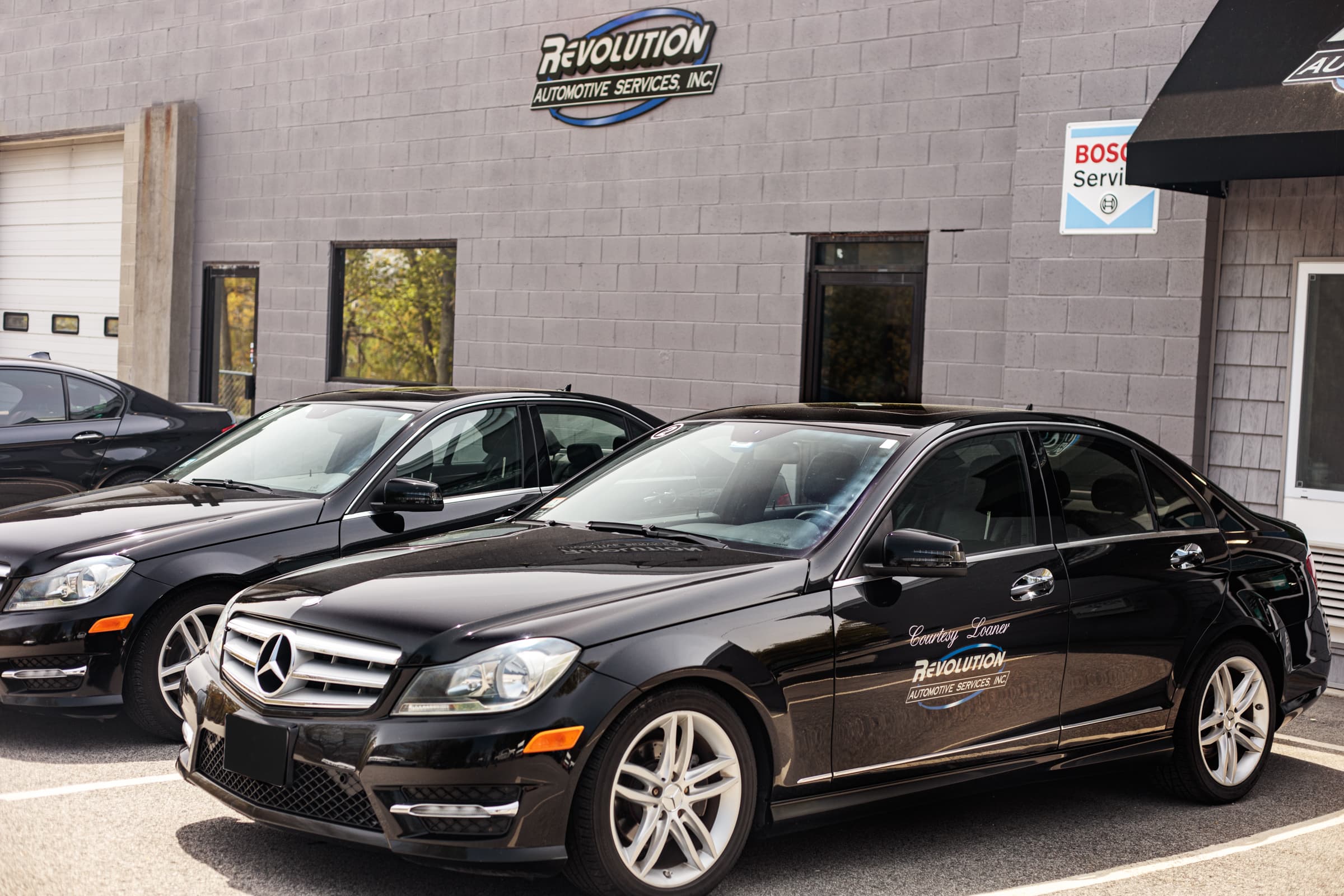
- •15 complimentary loaner vehicles so your schedule is not disrupted
- •Complimentary pickup and delivery within 10 miles of our Norwood location
- •Digital multi-point inspection reports with photos sent to your phone during the service
We are also consistently less expensive than franchised Mercedes-Benz dealers for the same quality of service. Most Norwood-area customers save 20 to 40 percent on repairs and maintenance versus dealer pricing — with no reduction in parts quality, fluid specification, or diagnostic accuracy. Under Massachusetts law, servicing your vehicle at an independent shop does not void your new-car warranty, provided the correct parts and fluids are used and records are maintained.
Signs Your Mercedes-Benz Needs Immediate Service
Some warning signs are schedule-when-convenient situations. These are not. Take any of the following seriously and do not delay:
- •Flashing check engine light — active misfire is damaging the catalytic converter; stop driving
- •"Stop Vehicle — Engine Overheating" message in the instrument cluster
- •Brake warning light or low brake fluid message
- •AIRMATIC suspension warning with visible sagging at a corner of the vehicle
- •"Gearbox: Please visit workshop" transmission warning
- •Burning oil smell, especially after a highway drive or immediately after parking
- •Any loss of power steering assist — sudden or gradual
- •ABS, ESP, and traction control lights illuminating simultaneously
- •Grinding, pulsing, or a significant increase in stopping distance when braking
- •Coolant warning light or steam from under the hood
Important
A flashing check engine light is a stop-now situation — not a drive-carefully situation. An active misfire sends unburned fuel into the catalytic converter, and the heat from the oxidation reaction can destroy it within miles. What would have been a $200 ignition coil becomes a $1,200 catalytic converter repair. Pull over safely and call Revolution Automotive at (781) 762-0013.
Serving Mercedes-Benz Owners in Norwood and Nearby Communities
Revolution Automotive is located at 433 Walpole Street in Norwood, MA — a central location in Norfolk County that puts us within easy reach of most of the region. We regularly service Mercedes-Benz vehicles for owners from Walpole, Westwood, and Canton, as well as Dedham, Sharon, Foxborough, Stoughton, and Medfield. If you're on Route 1, I-95, or Route 1A, we're straightforward to get to.
For customers who are further out or who can't easily drop off a vehicle during business hours, we offer complimentary pickup and delivery within a 10-mile radius. Our 15-car loaner fleet is available for most appointments, so your workday is not disrupted while your Mercedes is in for service.
If you've been searching for a Mercedes-Benz specialist near Norwood, a local alternative to dealer pricing, or simply a shop you can trust with a car you care about — we'd like the opportunity to earn that trust.
Schedule Mercedes-Benz Service in Norwood, MA
Whether you're due for routine Service A or B, tracking down a warning light, or looking for a better alternative to dealer pricing in the Norwood area, Revolution Automotive is ready to help. Contact us to schedule an appointment, call us directly at (781) 762-0013, or book online through our appointment system. We're open Monday through Friday, 7:30 AM to 5:00 PM, at 433 Walpole Street in Norwood, MA.
Your Mercedes-Benz was built to a high standard. The shop you trust with it should be, too.